Shape guide
Radiant Cut Lab-Grown Diamonds: Ratios, Depth and Checks
Last reviewed
Quick answer
A radiant is a square or rectangular diamond with cropped corners and brilliant faceting, pairing a crisp, straight-sided outline with lively sparkle. Common guidelines put square radiants at a length-to-width ratio of about 1.00 to 1.05 and rectangular ones at about 1.20 to 1.40, with depth around 61% to 67% and table around 61% to 69%. IGI grades a radiant’s cut, GIA does not; check the video for bow-tie, windowing and a facet pattern you like.
What is a radiant cut diamond?
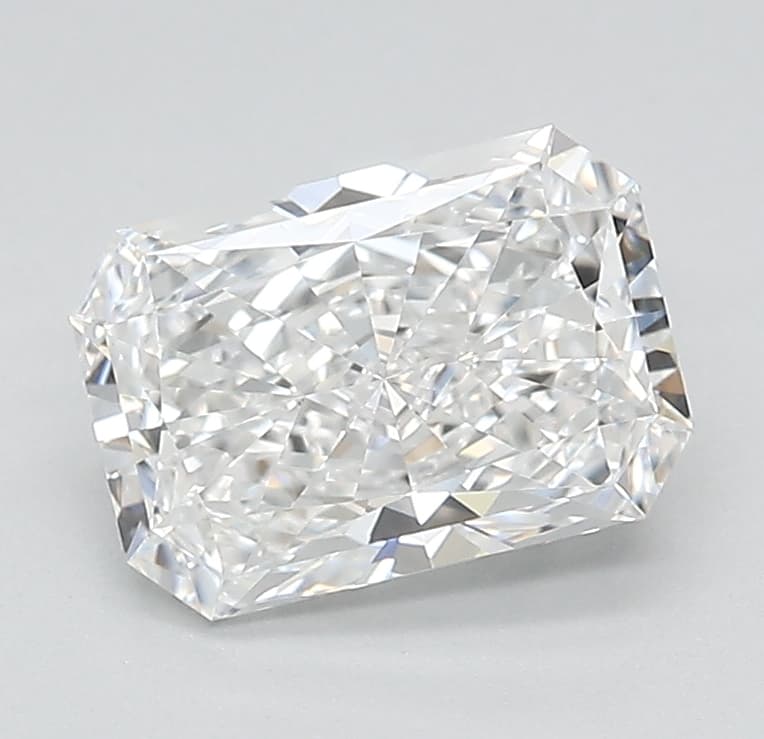
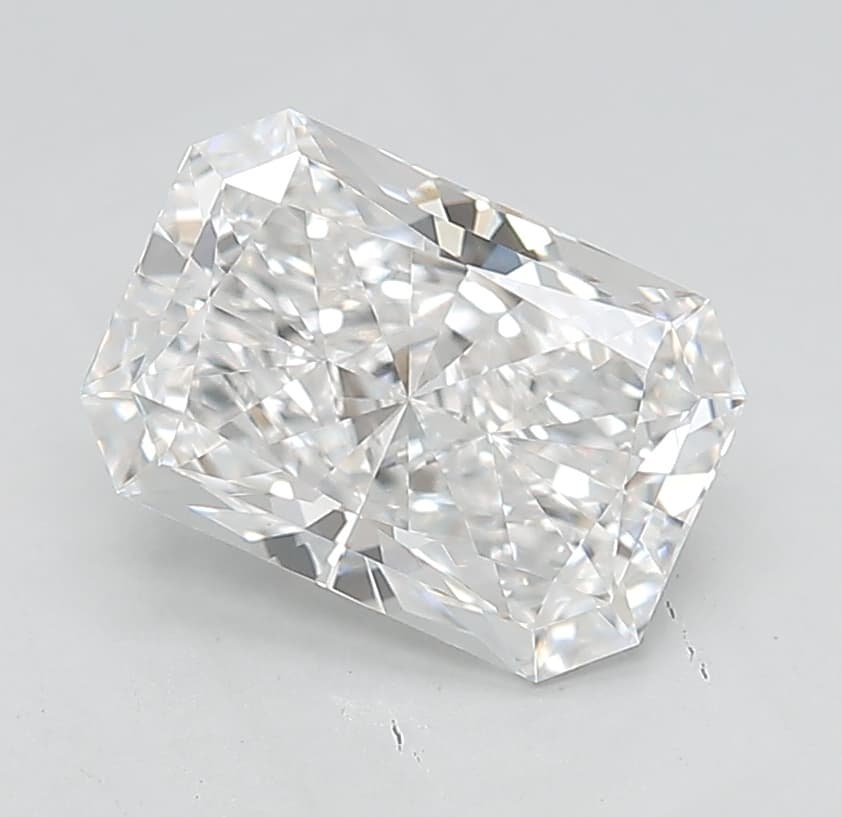
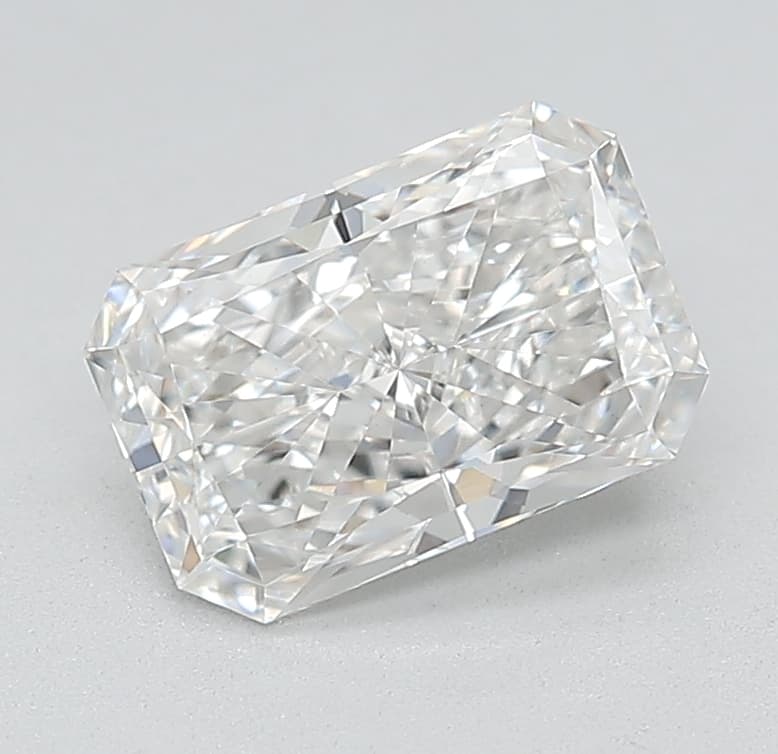
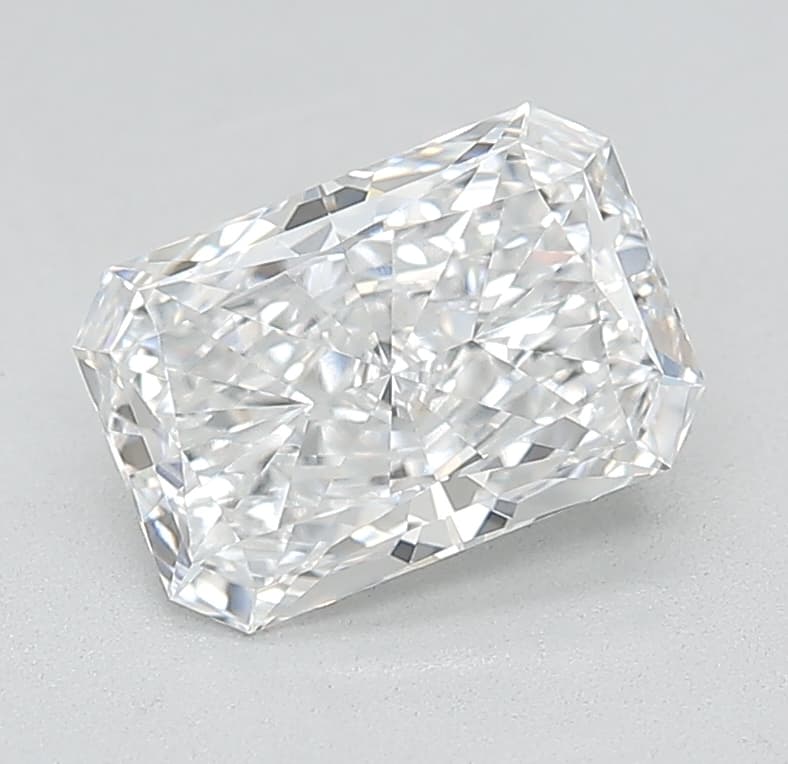
A radiant is a square or rectangular diamond with cropped (cut-off) corners and brilliant-style faceting on both the crown and the pavilion. It shares its outline with the emerald cut, but where an emerald cut has long, parallel step facets, a radiant has many smaller triangular and kite-shaped facets. The result is a lively, scattered sparkle in a straight-sided outline.
Radiants come in two broad looks. Many show a "crushed ice" pattern: lots of small, broken-up reflections, a little like the surface of crushed ice. Others show larger, more defined flashes. Neither is a grade or a flaw; it is a matter of taste, and the only reliable way to see which one a stone has is to watch the video.
IGI has graded the cut of fancy shapes, from Excellent to Poor, since September 2022; GIA does not. Either way, you judge a radiant’s cut from the proportions and from how the stone looks.
What proportions are commonly used for radiants?
Radiants are bought in two main outlines, square and rectangular, and the common guidelines differ for each:
| Measurement | Common guideline range |
|---|---|
| Length-to-width ratio, square | 1.00 to 1.05 |
| Length-to-width ratio, rectangular | 1.20 to 1.40 |
| Total depth | 61% to 67% |
| Table | 61% to 69% |
| Polish and symmetry | Excellent or Very Good |
These are common guidelines: sources vary slightly, and they are not lab rules. Stones between about 1.05 and 1.20 look neither clearly square nor clearly rectangular. Some people like that softly elongated outline; others prefer a definite choice. Ratios above 1.40 give a long, narrow stone, which suits some designs. Choose the outline first, then compare stones within it.
- RadiantTypical L/W1.00–1.05 square1.20–1.40 rectangular
- Typical L/W1.30–1.50
- Typical L/W1.00–1.05 square1.10–1.30 elongated
- Typical L/W1.00–1.05
What should you check before choosing a radiant?
- Bow-tie: elongated radiants can show a darker band across the middle, as ovals and pears do. A faint one that moves with the stone is normal; a wide, dark band that stays dark is not.
- Windowing: a washed-out, see-through center, usually from a pavilion that is too shallow.
- Depth and spread: radiants are commonly cut deeper than rounds (compare the ranges above with our round guide). Weight carried below the girdle does not add face-up size, so a very deep radiant looks small for its weight.
- Corners and sides: the four cropped corners should be similar in size, and the long sides should be straight and parallel.
- Facet look: decide whether you prefer crushed ice or larger flashes, and check the video for an even pattern without dark patches.
Read the measurements together: two radiants of the same carat weight can differ noticeably in length and width. One of our specialists can go through the report and video with you if you are unsure whether a stone’s proportions look right.
How do color and clarity show in a radiant?
Brilliant faceting breaks light into many small reflections, which tends to hide small inclusions better than the open facets of a step cut. A crushed-ice radiant in particular can make minor inclusions hard to spot, so radiants are generally forgiving on clarity. As with any shape, aim for an eye-clean stone and check the video rather than relying on the grade alone.
Color works a little differently. Radiants hide color fairly well, but their corners can hold a little more, so a near-colorless radiant can look slightly warmer at the corners than a round of the same grade. That tendency is one reason radiants are a common choice for fancy color diamonds, where saturated color is the point. If you want a white look, view the stone face-up in neutral light, and see the diamond color guide for how the grades step down.
How should a radiant cut diamond be set?
Cropped corners are one of the practical strengths of the radiant. A sharp 90-degree corner, as on a princess cut, is a weak point that can chip if it is knocked; cutting the corner off removes that point. Radiants are still usually set with a prong at each corner, often a claw or V-shaped prong, or in a bezel that covers the whole edge.
A rectangular radiant spreads its weight over a longer outline, so it tends to look longer and slimmer on the finger and can be set lengthwise or sideways. A square radiant gives a more compact, geometric look. Either way, compare the millimeter measurements of stones you are considering, because depth has a large effect on how big a radiant looks for its weight.
| Weight | Stones | Median length (mm) | Median width (mm) |
|---|---|---|---|
| 1.00–1.09 ct | 3 | 7.38 | 5.03 |
| 1.50–1.64 ct | 28 | 8.46 | 5.78 |
| 2.00–2.19 ct | 34 | 9.27 | 6.38 |
| 3.00–3.29 ct | 56 | 10.49 | 7.33 |
Frequently asked questions
What is the difference between a radiant and an emerald cut?
Both are square or rectangular with cropped corners. A radiant has brilliant-style facets that give a scattered sparkle, while an emerald cut has long, parallel step facets that give broad flashes of light. Radiants tend to hide inclusions better, while emerald cuts show clarity more openly.
What is a good length-to-width ratio for a radiant cut?
Common guidelines are about 1.00 to 1.05 for a square radiant and about 1.20 to 1.40 for a rectangular one. Sources vary slightly, and the choice is a matter of taste, so decide which outline you prefer first.
What does crushed ice mean in a radiant diamond?
Crushed ice describes a facet pattern made up of many small, broken-up reflections rather than larger, distinct flashes. It is not a grade or a flaw. Some people prefer it and others like bolder flashes, and a video is the only reliable way to tell which a stone has.
Do radiant cut diamonds have a bow-tie?
Elongated radiants can show a bow-tie, a darker band across the middle of the stone. A faint bow-tie that moves as the stone moves is normal; a wide, dark one that stays dark is worth avoiding. Reports do not grade it, so check the video.
Are radiant cut diamonds durable?
All diamonds are very hard, but any diamond can chip if it is struck at a weak point. The radiant’s cropped corners remove the sharp points that make some square shapes vulnerable, and prongs or a bezel at the corners add protection.