Shape guide
Emerald Cut Lab-Grown Diamonds: Clarity, Ratio and Proportions
Last reviewed
Quick answer
An emerald cut is a rectangular step cut with cropped corners: long, parallel facets create broad flashes of light rather than the busy sparkle of a brilliant. Common guidelines put the length-to-width ratio at about 1.30 to 1.50, with depth around 61% to 68% and table around 61% to 69%. Because the open table makes inclusions and body color easier to see, many buyers choose a higher clarity and color grade for an emerald cut than for a round.
What is an emerald cut diamond?
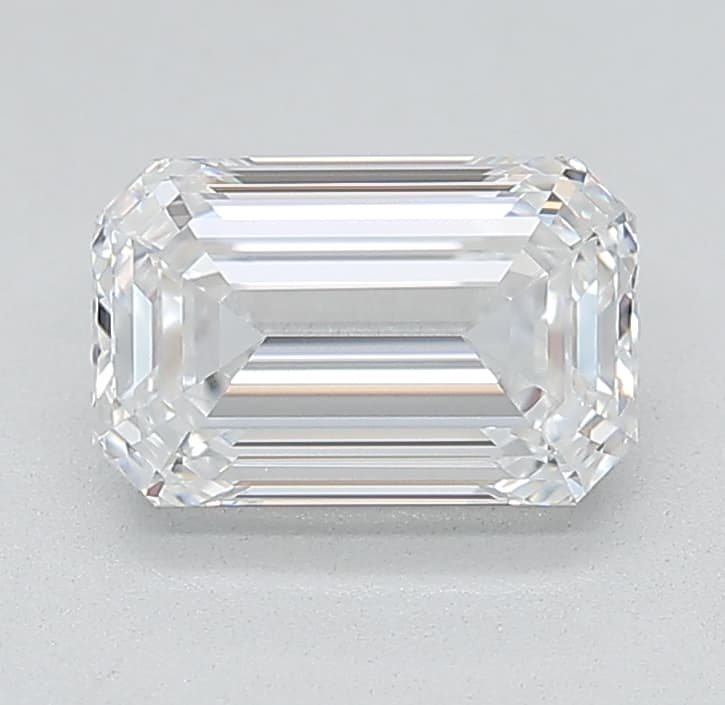
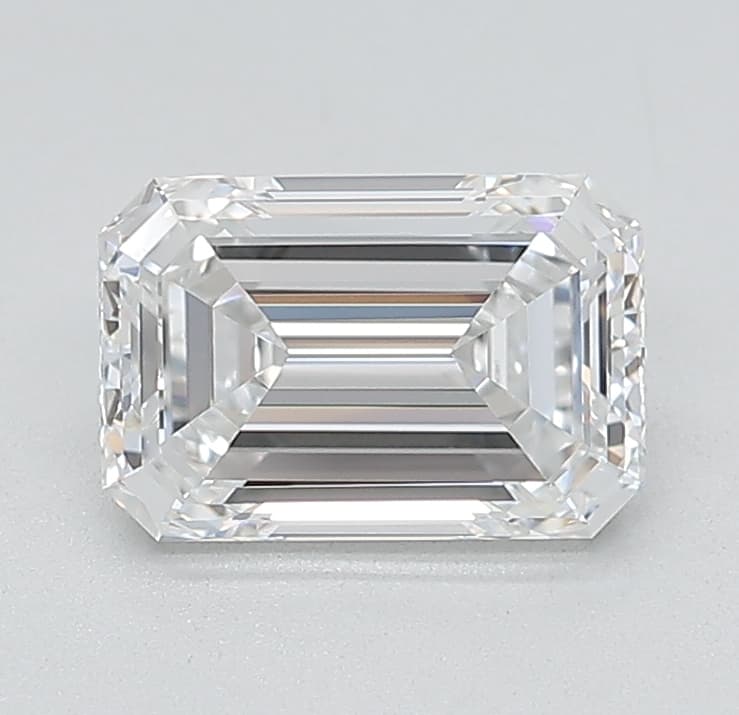
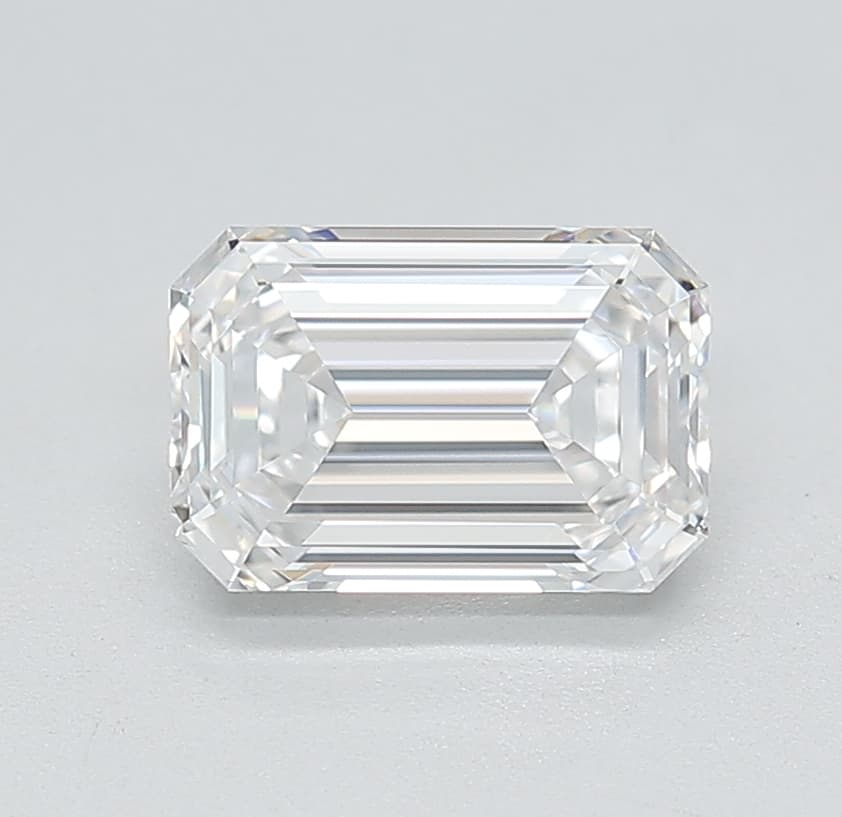
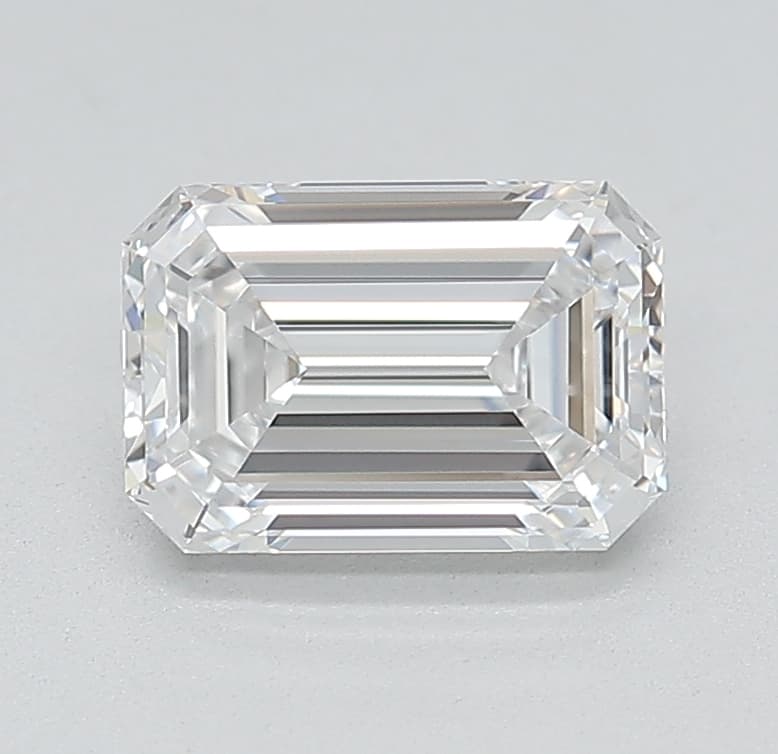
An emerald cut is a rectangular diamond with cropped corners, faceted as a step cut. Instead of the triangular and kite-shaped facets of a brilliant, it has long, flat facets arranged in rows (steps) parallel to the edges, on both the crown and the pavilion. The pavilion usually ends in a short ridge, called a keel line, rather than a single point.
That layout gives a different look from a round or oval. Rather than many small sparkles, an emerald cut shows broad flashes of light and dark that open and close as the stone moves, often called the hall of mirrors effect. It is a calmer, more architectural look, and it puts the clarity of the stone on display.
A square step cut with cropped corners and a windmill-like pattern is the Asscher cut, and some reports describe nearly square emerald cuts as well. If you like the outline but want more sparkle, the radiant has the same outline with brilliant faceting.
What proportions are commonly used for emerald cuts?
| Measurement | Common guideline range |
|---|---|
| Length-to-width ratio | 1.30 to 1.50 |
| Total depth | 61% to 68% |
| Table | 61% to 69% |
| Polish and symmetry | Excellent or Very Good |
These are common guidelines that vary slightly by source, not lab rules. IGI has graded the cut of fancy shapes, from Excellent to Poor, since September 2022; GIA does not. With or without a cut grade, these numbers, the polish and symmetry grades and the video are what you have to judge the cut.
Within the range, the ratio is a matter of taste. A stone near 1.30 looks more compact; one near 1.50 is a longer, slimmer rectangle. Ratios above that look long and narrow and suit some designs. Decide on the outline first, then compare stones within it.
- EmeraldTypical L/W1.30–1.50
- Typical L/W1.00–1.05
- Typical L/W1.00–1.05 square1.20–1.40 rectangular
What should you check before choosing an emerald cut?
- Windowing: with a step cut, a pavilion that is too shallow lets light pass straight through, leaving a pale, see-through area in the center. A large window makes the stone look glassy and flat.
- Even steps: the rows of facets should be evenly spaced and parallel, with the keel line centered. Uneven steps disturb the hall-of-mirrors pattern.
- Corners and sides: the four cropped corners should be similar in size, and the long sides straight and parallel.
- Inclusions under the table: the open table works like a window into the stone, so look for anything visible in the center (see the next section).
- Light and dark: a well-cut emerald cut alternates bright and dark flashes as it moves. Large areas that stay dark, or a stone that looks flat and lifeless, suggest the proportions are off.
A clear video in diffused light shows these things far better than still photos. One of our specialists can go through the measurements and video with you before you buy.
Why do clarity and color matter more in an emerald cut?
The large, flat table and long facets of a step cut give a clear view into the diamond, with little of the busy sparkle that helps hide inclusions in a brilliant. Inclusions that a round would mask can be easy to see in an emerald cut. For that reason many buyers choose a higher clarity grade for an emerald cut than for a round, often in the VS range or above. The grade is only a guide, though: the goal is an eye-clean stone, so check the video, especially the center of the table.
Step cuts also tend to show body color more readily, because their broad facets show the diamond’s own color more directly than the busy reflections of a brilliant. Many buyers therefore choose a slightly higher color grade for an emerald cut, while some pick a warmer grade on purpose for a vintage look. A brown, green or milky tinge can also be easier to notice in a step cut and is not graded on reports, so look carefully at the video. See the diamond clarity and diamond color guides for the full scales.
| Grade | Name | At 10× magnification | To the unaided eye |
|---|---|---|---|
| FL | Flawless | No inclusions or blemishes | Clean |
| IF | Internally Flawless | No inclusions; only minor surface blemishes | Clean |
| VVS1 | Very, Very Slightly Included 1 | Inclusions so slight they are very hard to find | Eye-clean |
| VVS2 | Very, Very Slightly Included 2 | Inclusions so slight they are very hard to find | Eye-clean |
| VS1 | Very Slightly Included 1 | Minor inclusions, difficult to somewhat easy to find | Usually eye-clean in brilliant shapes |
| VS2 | Very Slightly Included 2 | Minor inclusions, difficult to somewhat easy to find | Usually eye-clean in brilliant shapes |
| SI1 | Slightly Included 1 | Noticeable inclusions | Varies: some are eye-clean, some show an inclusion |
| SI2 | Slightly Included 2 | Noticeable inclusions | Varies: inclusions are more often visible |
| I1 | Included 1 | Obvious inclusions that may affect transparency and brilliance | Often visible |
| I2 | Included 2 | Obvious inclusions that may affect transparency and brilliance | Often visible |
| I3 | Included 3 | Obvious inclusions that may affect transparency and brilliance | Often visible |
How big does an emerald cut look, and how should it be set?
Face-up size depends a great deal on depth. An emerald cut within the common depth range shows a broad, open table, while one cut much deeper carries weight below the girdle that does not show from the top, so it looks small for its weight. Compare the length and width in millimeters across stones of similar weight rather than relying on carat weight.
The cropped corners protect the stone: a sharp 90-degree corner is a weak point that can chip, and cutting it off removes that point. Emerald cuts are usually set with a prong at each corner, often a claw or V-shaped prong, or in a bezel. They can be set lengthwise or sideways (east-west), and set lengthwise the long outline tends to make the finger look longer.
| Weight | Stones | Median length (mm) | Median width (mm) |
|---|---|---|---|
| 1.50–1.64 ct | 4 | 8.10 | 5.37 |
| 2.00–2.19 ct | 5 | 8.83 | 5.83 |
| 3.00–3.29 ct | 27 | 10.02 | 6.86 |
Frequently asked questions
What clarity should I choose for an emerald cut diamond?
Step cuts show inclusions more readily than brilliants, so many buyers choose a higher clarity grade for an emerald cut, often in the VS range or above. The grade is only a guide: check a video to confirm the stone is eye-clean, especially in the center of the table.
What is the best length-to-width ratio for an emerald cut?
Commonly cited guidelines run from about 1.30 to 1.50. Lower ratios look more compact and higher ratios longer and slimmer, so the best ratio is the outline you prefer.
What is the hall of mirrors effect?
It describes how the long, parallel step facets of an emerald cut produce broad flashes of light and dark that open and close as the stone moves. It is a calmer look than the scattered sparkle of a round or oval, and it is clearest in a well-proportioned step cut.
What is the difference between an emerald cut and an Asscher cut?
Both are step cuts with cropped corners. An emerald cut is usually rectangular, while an Asscher cut is square, with a step pattern that often looks like a windmill when viewed from the top.
Do emerald cut diamonds sparkle?
They do, but differently from brilliants. An emerald cut shows broad, bright flashes rather than many small points of light. If you want the emerald outline with more sparkle, a radiant cut has the same outline with brilliant faceting.