Guide
Diamond Color: The D-to-Z Scale for Lab-Grown Diamonds
Last reviewed
Quick answer
Diamond color grades how close a white diamond is to colorless, on a scale from D (colorless) to Z (light yellow or brown). D to F are colorless and G to J near colorless, and many buyers find near-colorless grades look white once set. Lab-grown diamonds are graded on the same scale, although since October 2025 GIA classes colorless to near-colorless lab-grown stones as Premium or Standard instead of giving a letter grade.
The D-to-Z diamond color scale
Color grades for white diamonds measure the absence of color. The scale starts at D and runs to Z, with each letter showing a little more yellow or brown body color than the one before. GIA created the scale, and IGI uses the same letters.
| Grades | Group | What it means in practice |
|---|---|---|
| D, E, F | Colorless | No color, or traces a grader detects only against master stones |
| G, H, I, J | Near colorless | Slight color when compared face-down; often hard to see face-up |
| K, L, M | Faint | A faint warm tint that many people can see face-up |
| N to R | Very light | Light yellow or brown, visible face-up |
| S to Z | Light | Clearly visible yellow or brown |
Each grade covers a narrow range, and the step between neighboring grades is small. Within the colorless group, D, E and F are very hard to tell apart without master stones. A diamond with more color than Z, or with a distinct hue such as blue or pink, is described on a separate fancy-color scale instead.
| Grade | Group | What it means |
|---|---|---|
| D | Colorless | No color, or traces a grader detects only against master stones |
| E | Colorless | No color, or traces a grader detects only against master stones |
| F | Colorless | No color, or traces a grader detects only against master stones |
| G | Near colorless | Slight color when compared face-down; often hard to see face-up |
| H | Near colorless | Slight color when compared face-down; often hard to see face-up |
| I | Near colorless | Slight color when compared face-down; often hard to see face-up |
| J | Near colorless | Slight color when compared face-down; often hard to see face-up |
| K | Faint | A faint warm tint that many people can see face-up |
| L | Faint | A faint warm tint that many people can see face-up |
| M | Faint | A faint warm tint that many people can see face-up |
How labs grade diamond color
Color is graded under conditions designed to take the guesswork out:
- Face-down. The diamond is placed table-down on a neutral white surface and viewed through the side of the pavilion. Face-up, the sparkle from the facets hides body color, so grading face-down shows the color itself.
- Against master stones. The grader compares the diamond with a set of master stones of known color and assigns a grade based on where it falls among them.
- Under controlled light. Grading uses standardized, daylight-equivalent lighting in a neutral viewing environment, so the light source does not shift the result.
IGI grades lab-grown diamonds on the full D-to-Z scale. GIA did the same on lab-grown reports issued from October 13, 2020 to September 30, 2025; before October 2020 it gave ranges such as "colorless". Since October 1, 2025, GIA’s Laboratory-Grown Diamond Quality Assessment for colorless to near-colorless lab-grown diamonds no longer gives a letter grade: a Premium stone must be D color, a Standard stone can be anywhere from D to J, and a stone below J receives no assessment. GIA lab-grown reports issued from October 2020 to September 2025 still show the letter grade. See our guide to diamond certificates for more on both labs.
How color shows face-up: shape, size and metal
A grade describes the stone face-down in a lab. Once a diamond is set and seen face-up, several things change how much color you notice. These are tendencies, not rules:
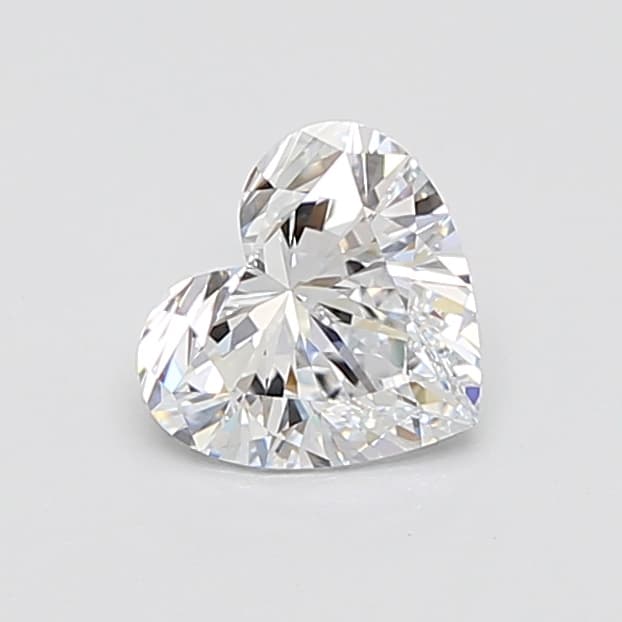
- Shape. Brilliant cuts such as round, oval, cushion and radiant scatter light into many small flashes, which tends to mask slight color. Step cuts such as emerald and asscher have broad, open facets that show body color more readily.
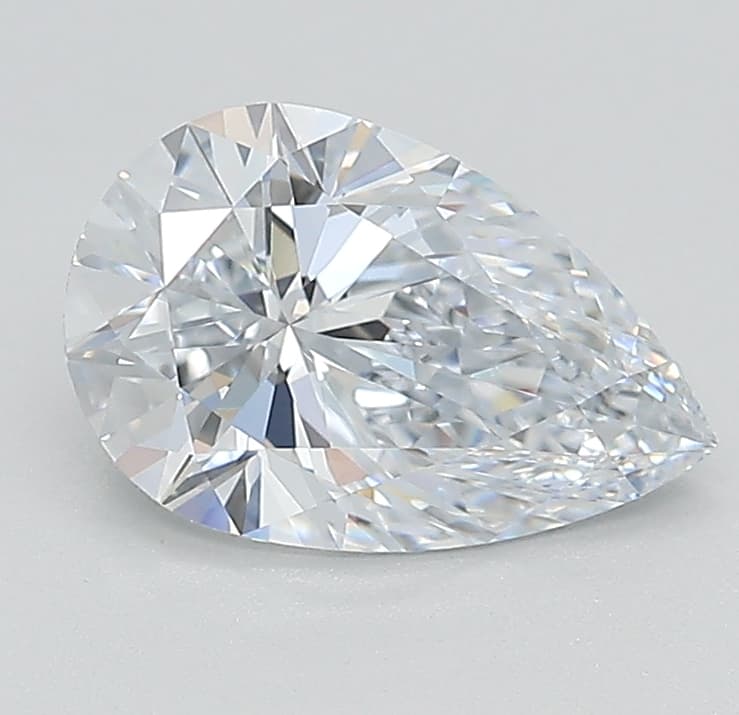
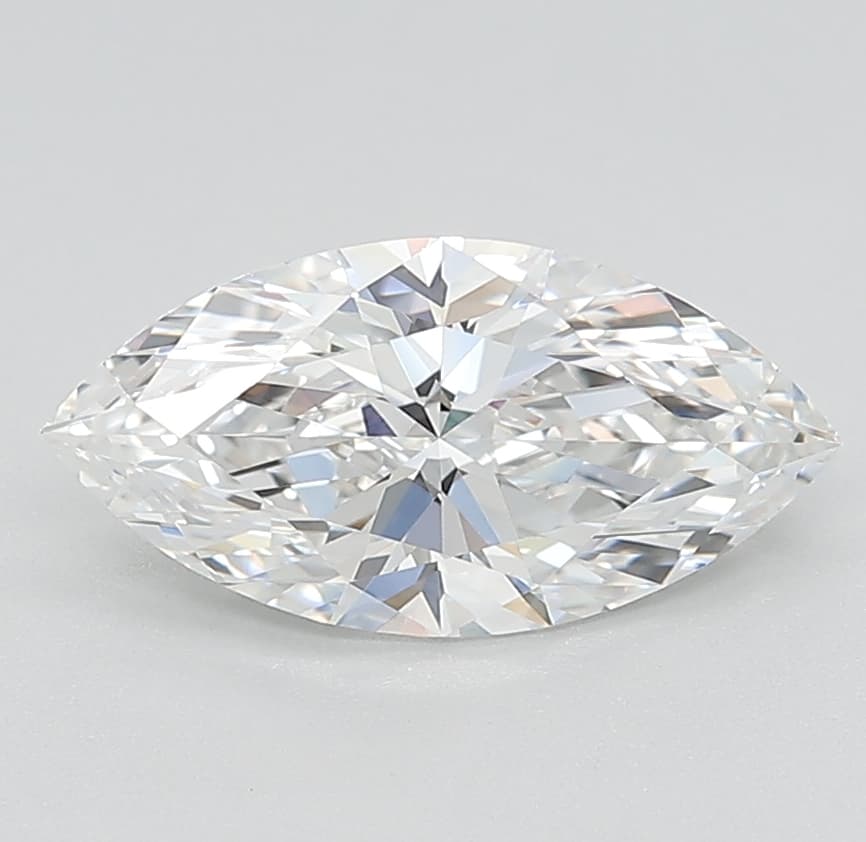
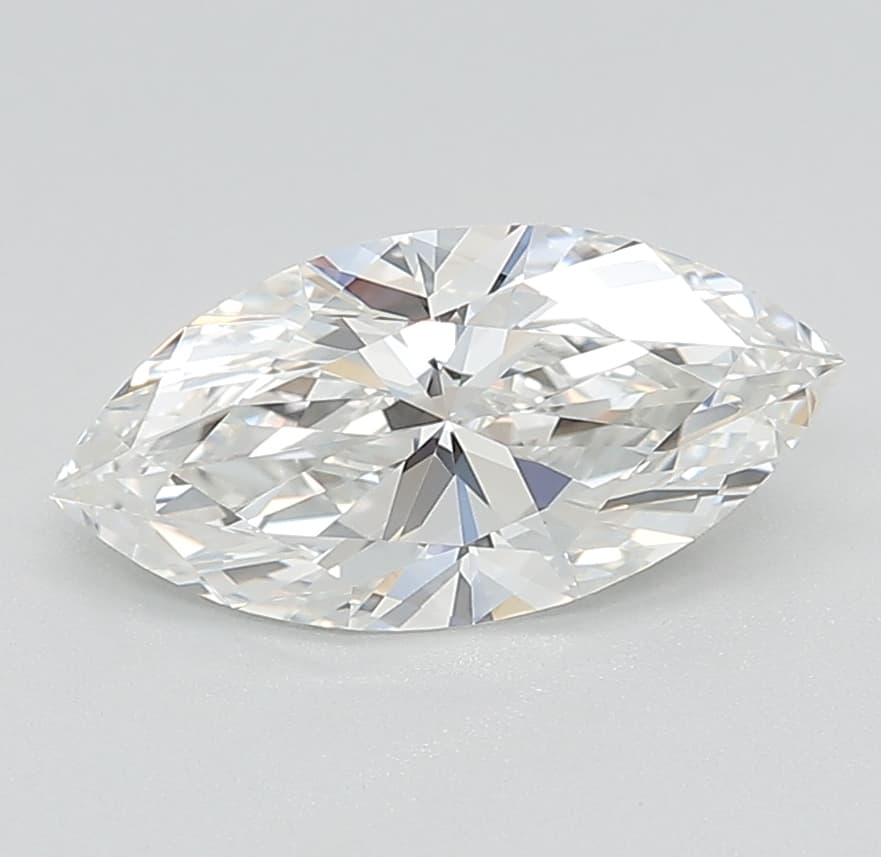
- Points and ends. In pointed and elongated shapes such as pear, marquise and oval, color can look more concentrated at the tips.
- Size. Larger stones tend to show color more, because light travels further through them.
- Metal. Yellow and rose gold surround the stone with warm tones, which makes a slight warm tint harder to notice. Platinum and white gold can make the same tint easier to see by contrast.
- Fluorescence. Fluorescence can change how a stone looks in daylight or other light with a strong ultraviolet component. IGI reports grade it separately, from None to Very Strong; GIA’s lab-grown assessment since October 2025 does not show it.
Common advice is to look at G or H for a brilliant shape in platinum or white gold, and to consider grades down to I or J, and sometimes K, for yellow or rose gold. For step cuts and larger stones, many buyers move up a grade or two. Either way, check a video of the stone.
| Grade | What it means |
|---|---|
| None | No visible reaction to long-wave UV |
| Faint | A weak glow |
| Medium | A clearly visible glow |
| Strong | A pronounced glow |
| Very Strong | The most intense reaction on the scale |
Tinge and BGM: what the color grade does not show
The color grade measures how much color a diamond has. It does not fully capture undertones, which the trade often sums up as BGM: brown, green or milky (hazy). A tinge can make a stone look slightly brownish, greenish or hazy even when its color grade is good.
Tinge is not graded on IGI or GIA reports, so the report alone cannot rule it out. Useful checks are a video in neutral light and a second opinion: you can ask one of our specialists to look at the video with you before you buy.
Color in lab-grown diamonds: as grown or treated
Lab-grown diamonds are graded on the same color scale as mined diamonds, but how they reach their final color can differ by growth method:
- CVD diamonds are grown layer by layer from a carbon-rich gas. Many CVD diamonds receive post-growth treatment, for example HPHT annealing, to improve their color.
- HPHT diamonds are grown under very high pressure and temperature. Near-colorless HPHT stones are typically type IIa, sometimes type IIb with traces of boron.
HPHT annealing, the treatment, is a different thing from HPHT growth, even though they share a name. IGI reports address treatment in the comments: since January 2021, a stone with no detected treatment is described as "As Grown – No indication of post-growth treatment", while other reports can state that the stone may include post-growth treatment. GIA’s lab-grown assessment since October 2025 has no treatment statement. See as grown vs post-growth treatment for what the wording means.
The color grade describes the stone as it is now, after any treatment. Some buyers prefer an as-grown stone; neither growth method is better by default. Judge each stone by its report and how it looks, and see CVD vs HPHT for more on the two methods.
Fancy-color lab-grown diamonds
Diamonds with a distinct hue such as blue, pink or yellow, or with more color than Z, are graded as fancy colors. Instead of a letter, the report describes the hue and its intensity, with terms such as Fancy Light, Fancy, Fancy Intense, Fancy Vivid and Fancy Deep. For fancy colors, stronger and purer color is usually valued more, the reverse of the D-to-Z scale.
In lab-grown diamonds, some colors come from the growth itself: boron gives blue (type IIb) and nitrogen gives yellow. Other colors can come from post-growth treatment, so read the report comments for any indication of treatment.
Frequently asked questions
What is a good color grade for a lab-grown diamond?
There is no single right answer. A common choice is G or H, which many people see as white face-up once set, or D to F if you want a stone that is colorless by grade. For step cuts, large stones and platinum or white gold settings, many buyers move up a grade.
Can you see the difference between D and G color?
Face-down, side by side against master stones, a trained grader can. Face-up and set in jewelry, many people find it hard to tell them apart, especially in brilliant shapes. Differences are easier to notice in step cuts and larger stones.
Are lab-grown diamonds treated to improve color?
Some are. Many CVD diamonds receive post-growth treatment, such as HPHT annealing, to improve their color. Since January 2021, IGI reports describe a stone as As Grown when there is no indication of post-growth treatment, so read the comments on the report.
Does the metal of the setting change how white a diamond looks?
It can. Yellow and rose gold make a slight warm tint harder to notice, which is why near-colorless and faint grades are often set in those metals. Platinum and white gold can make a tint easier to see by contrast.
Why does my GIA lab-grown report not show a color grade?
Since October 1, 2025, GIA assesses colorless to near-colorless lab-grown diamonds as Premium or Standard instead of giving a letter grade. Premium requires D color along with its other criteria, and Standard covers stones from D to J that meet its minimums. GIA lab-grown reports issued from October 13, 2020 to September 30, 2025 still show a D-to-Z grade; earlier ones show ranges.