Shape guide
Pear-Shaped Lab-Grown Diamonds: Ratio, Symmetry and Setting
Last reviewed
Quick answer
A pear is a teardrop-shaped modified brilliant with one rounded end and one point. Common guidelines put the length-to-width ratio at about 1.45 to 1.75 (many people like 1.55 to 1.70), with depth around 58% to 64% and table around 53% to 63%. IGI grades a pear’s cut, GIA does not; judge pears on symmetry too: the point should line up with the center of the rounded end, the sides should mirror each other, and the setting should protect the point.
What is a pear-shaped diamond?
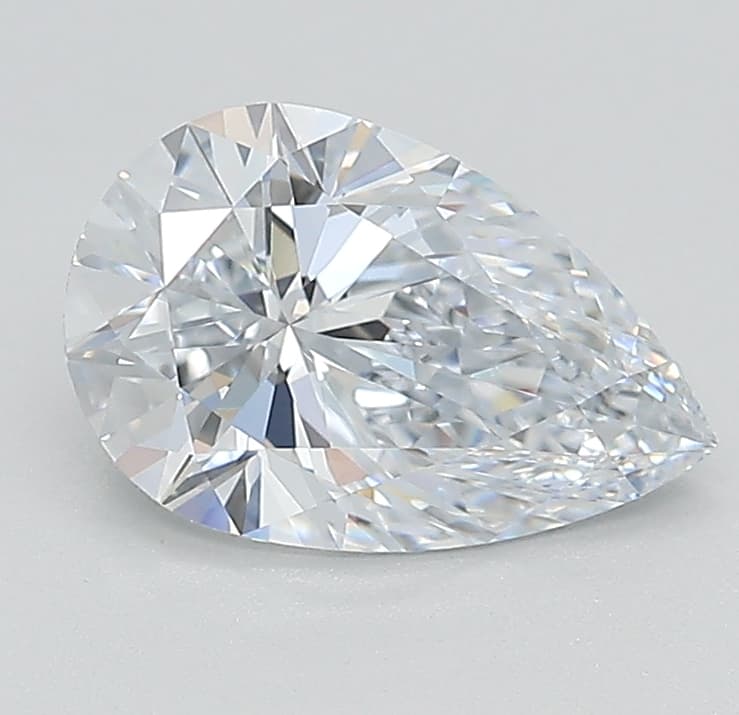
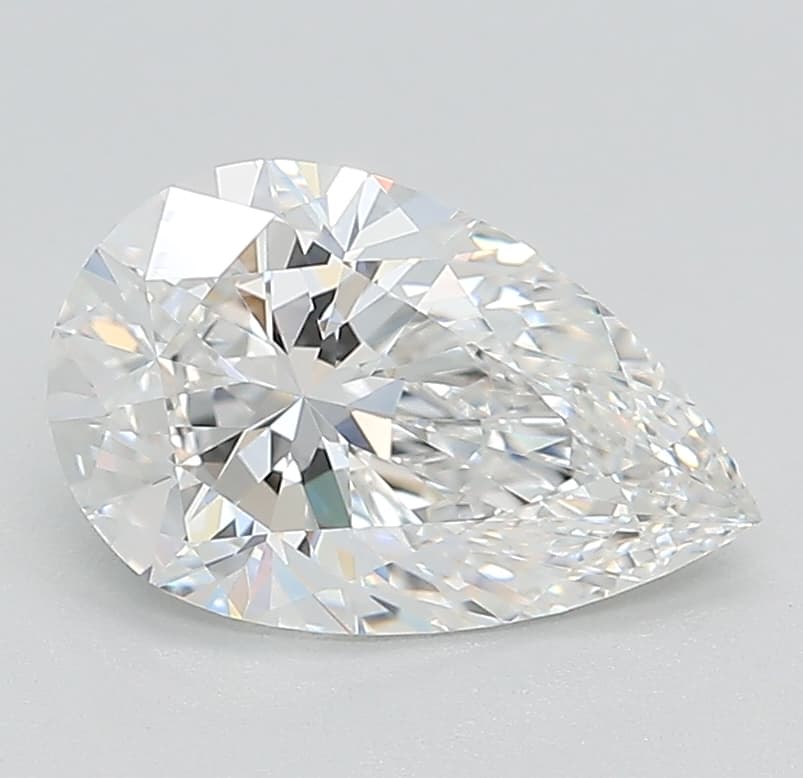
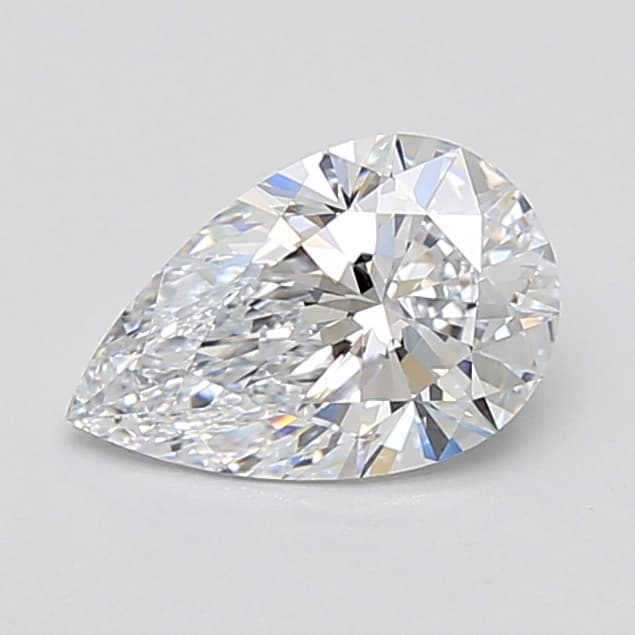
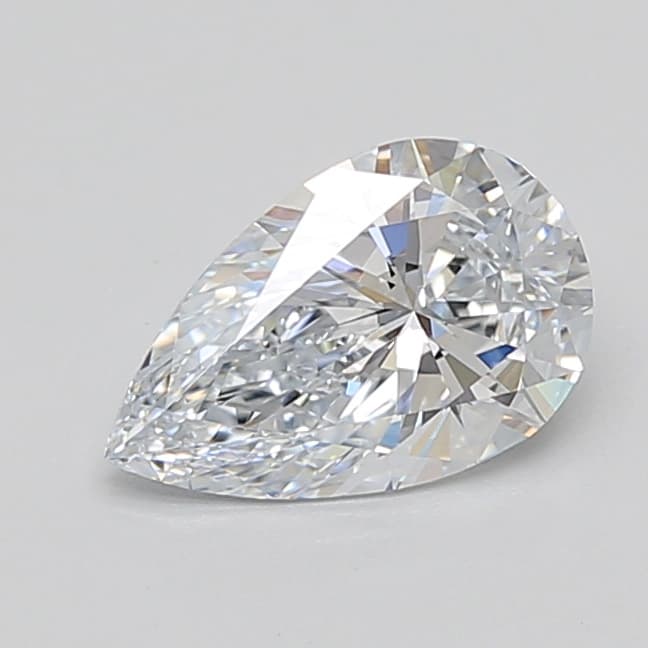
A pear, sometimes called a teardrop, has one rounded end (the head) and one point. It is a modified brilliant, faceted for a scattered sparkle like a round, and its outline combines the curve of an oval with the point of a marquise.
Most pears are set in rings with the point toward the fingertip, but that is a tradition rather than a rule, and pendants are often hung point-down. Because the stone is elongated, it tends to look larger face-up than a round of the same weight and can make the finger look longer.
IGI has graded the cut of fancy shapes, from Excellent to Poor, since September 2022; GIA does not. Even with a cut grade, the outline and the video matter more than for a round. With a pear, symmetry is easy to see with the naked eye: a crooked point or uneven sides show at a glance.
What proportions are commonly used for pear diamonds?
Use these ranges to screen stones before you look closely at the outline:
| Measurement | Common guideline range |
|---|---|
| Length-to-width ratio | 1.45 to 1.75 (many people like 1.55 to 1.70) |
| Total depth | 58% to 64% |
| Table | 53% to 63% |
| Polish and symmetry | Excellent or Very Good |
These are common guidelines that vary slightly by source, not lab rules. Within them, the ratio is mostly about taste. A pear near 1.45 has a fuller, wider head; one near 1.75 is long and slender. Very low ratios can look stubby and very high ones narrow, though both suit some designs. A deep pear carries weight below the girdle that does not show face-up, and a very shallow one is more likely to show a washed-out, see-through center.
- Typical L/W1.30–1.50
- PearTypical L/W1.45–1.75
- Typical L/W1.75–2.25
- Typical L/W0.90–1.10
How do you judge the outline and symmetry of a pear?
Look at the stone face-up in a photo or video and check:
- The point lines up with the head: imagine a line from the tip of the point through the center of the rounded end. It should split the stone into two mirror images. A point that sits off to one side looks crooked once the stone is set.
- The head is a smooth, full curve: not flattened across the top and not narrow or pinched.
- The shoulders are even: the shoulders are where the head starts to curve down toward the point. They should sit at the same height on both sides and not look squared off.
- The wings are gently curved: the sides running down to the point should curve slightly outward. Wings that bulge make the stone look chubby; wings that are too straight make it look thin and angular.
The symmetry grade on the report considers the outline as well as facet placement, so Excellent or Very Good is a useful filter. With this shape, though, your own eye on the outline counts for more than the grade.
Does a pear diamond have a bow-tie?
Most pears show some bow-tie: a darker band running across the widest part of the stone, where light is not returned to your eye as strongly. It is a normal feature of elongated brilliants. A faint bow-tie that flickers and shifts as the stone moves is fine; a broad, dark band that stays dark from every angle makes the stone look as if a shadow lies across it.
Two other things to watch for in the video:
- Windowing: a pale, see-through area in the center, usually from a shallow pavilion.
- Extinction: dark patches, beyond the bow-tie, that do not light up as the stone moves.
Videos taken in even, diffused light show these effects more clearly than bright spotlights, which can make almost any stone sparkle.
How do color and clarity show in a pear?
Color tends to gather toward the ends of elongated shapes, so a pear can look slightly warmer at the point than in the center. In the colorless range this rarely matters. In the near-colorless range, look at the point in the video, and consider whether a slightly higher color grade suits you.
Brilliant faceting hides small inclusions fairly well, so pears are reasonably forgiving on clarity. Two things are worth checking. Inclusions under the table are the easiest to see, so aim for an eye-clean stone rather than a particular grade. And a feather (a small internal fracture) close to the point is worth asking about, because the point is the most exposed part of the stone. One of our specialists can look at the report and video with you.
How big does a pear look, and how should it be set?
Like other elongated shapes, pears tend to look larger face-up than round diamonds of the same carat weight, because the weight is spread over a longer outline. How much larger depends on the ratio and depth, so compare the length and width in millimeters across stones rather than relying on carat weight alone.
The point needs protection. Most pear settings use a V-shaped prong (sometimes called a chevron) over the tip, with prongs around the rounded head, or a bezel around the whole stone. An uncovered point can chip if it is knocked in the wrong place. If you plan to wear the ring next to a wedding band, check how the band will sit against the point.
| Weight | Stones | Median length (mm) | Median width (mm) |
|---|---|---|---|
| 1.00–1.09 ct | 8 | 9.11 | 5.66 |
| 1.50–1.64 ct | 38 | 10.50 | 6.49 |
| 2.00–2.19 ct | 29 | 11.57 | 7.12 |
| 3.00–3.29 ct | 21 | 13.09 | 8.12 |
Frequently asked questions
What is the best length-to-width ratio for a pear diamond?
Commonly cited guidelines run from about 1.45 to 1.75, and many people like 1.55 to 1.70. Lower ratios give a fuller, wider pear and higher ratios a longer, slimmer one, so the choice is a matter of taste.
Which way should a pear diamond point on a ring?
Most pears are set with the point toward the fingertip, which tends to make the finger look longer. Pointing it toward the wrist is less common but entirely a personal choice. Either way, the point should be protected by a prong or bezel.
Why does a pear diamond need a V-prong?
The point is the thinnest and most exposed part of a pear, so it is the most likely place to chip if the stone is knocked. A V-shaped prong or a bezel covers the tip and protects it.
Do pear diamonds have a bow-tie?
Most do, as a darker band across the widest part of the stone. A faint bow-tie that changes as the stone moves is normal; a wide, dark band that stays dark is the thing to avoid. Reports do not grade it, so check the video.
Does a pear diamond look bigger than a round?
Pears tend to look larger face-up than rounds of the same carat weight, because the weight is spread over a longer outline. Compare the length and width in millimeters to see the difference for specific stones.