Color & Carat
Carat Sweet Spots: 1.9 Carats vs 2.0 and Other Just-Under Sizes
By the Vanora Diamond team
Published Last reviewed 5 min read

Quick answer
Diamond prices are often set in weight brackets that start at round numbers such as 1.00, 1.50, 2.00 and 3.00 carats, while face-up size changes only slightly just below them. A well-cut 1.90 ct round is about 8.0 mm across, only around 0.15 mm smaller than a 2.00 ct, so a stone just under a threshold can look almost the same. Compare millimeters and live prices on both sides before you decide.
What a carat sweet spot is
Diamonds are commonly priced by weight bracket, and the brackets tend to begin at round numbers: whole carats, half carats and a few others. When a stone crosses into the next bracket, its price can step up noticeably, even though the extra weight is tiny. These threshold weights are sometimes called "magic sizes" in the trade, and the carat weight guide touches on them.
A sweet spot is the range just below a threshold, such as 1.80 to 1.99 ct rather than 2.00 ct. You give up a few points of weight (one point is 0.01 ct) and, often, very little visible size.
How big the price step is varies from stone to stone and changes over time, and it applies to lab-grown diamonds as well as mined ones. That is why the only reliable comparison is between actual, live listings on both sides of the line, rather than a rule of thumb.
| Weight | Stones | Median price per carat |
|---|---|---|
| Under 1 ct | 12 | $123 |
| 1–1.49 ct | 48 | $114 |
| 1.5–1.99 ct | 23 | $118 |
| 2–2.49 ct | 25 | $191 |
| 2.5–2.99 ct | 46 | $207 |
| 3–3.49 ct | 76 | $208 |
| 3.5–3.99 ct | 64 | $259 |
| 4–4.99 ct | 80 | $438 |
| 5–5.99 ct | 75 | $662 |
| 6–6.99 ct | 16 | $1,385 |
| 7–7.99 ct | 12 | $144 |
Why size barely changes just under a threshold
Carat weight follows volume, and volume grows in three dimensions. Diameter only grows with the cube root of weight, so a 5% drop in weight shrinks the diameter of a round by only about 1.7%, and its face-up area by about 3.4%.
The table uses the common estimate for rounds, carat ≈ diameter² × depth × 0.0061, all in millimeters, with the depth at about 61.5% of the diameter. Treat every figure as approximate:
| Just under | Approx. diameter | Round weight | Approx. diameter | Difference |
|---|---|---|---|---|
| 0.90 ct | 6.21 mm | 1.00 ct | 6.44 mm | about 0.23 mm |
| 1.40 ct | 7.20 mm | 1.50 ct | 7.37 mm | about 0.17 mm |
| 1.90 ct | 7.97 mm | 2.00 ct | 8.11 mm | about 0.14 mm |
| 2.90 ct | 9.18 mm | 3.00 ct | 9.28 mm | about 0.10 mm |
| 3.90 ct | 10.13 mm | 4.00 ct | 10.22 mm | about 0.09 mm |
| 4.90 ct | 10.93 mm | 5.00 ct | 11.00 mm | about 0.07 mm |
A tenth of a millimeter is about the thickness of a sheet of paper. Once the stone is in a setting, with prongs over its edge, differences this small are very hard to see. And for the same 0.10 ct gap, the difference in size shrinks as the weight goes up.
| Weight | Stones | Median length (mm) | Median width (mm) |
|---|---|---|---|
| 1.80–1.97 ct | 7 | 7.95 | 7.99 |
| 2.00–2.19 ct | 17 | 8.20 | 8.26 |
| 2.70–2.96 ct | 18 | 9.01 | 9.05 |
| 3.00–3.29 ct | 51 | 9.38 | 9.42 |
Cut can matter more than the last tenth of a carat
Two stones of different weights can face up the same size if they are cut differently. Using the same estimate, a 2.00 ct round cut to about 64% depth and a 1.90 ct round cut to about 60.5% depth both measure roughly 8.0 mm across. The heavier stone simply carries more of its weight below the girdle, where you cannot see it.
A thick girdle does the same. So when you compare a just-under stone with a round-number one:
- For rounds, compare the diameters on the IGI reports or our stone pages directly.
- For fancy shapes, multiply length by width for each stone; the larger product shows more surface face-up. Keep the length-to-width ratio similar so you are comparing like with like.
- Check depth percentage against the common range for the shape. A stone that is "heavy for its size" may be deep rather than better.
Where the sweet spots usually sit
The ranges people most often look at sit just under the common thresholds:
| Look at | Instead of | Browse |
|---|---|---|
| 0.90 to 0.99 ct | 1.00 ct | Under 1 carat |
| 1.40 to 1.49 ct | 1.50 ct | 1 carat |
| 1.80 to 1.99 ct | 2.00 ct | 1.5 carat |
| 2.80 to 2.99 ct | 3.00 ct | 2.5 carat |
| 3.80 to 3.99 ct | 4.00 ct | 3.5 carat |
| 4.80 to 4.99 ct | 5.00 ct | 4 carat |
Stones are not spread evenly across weights. Cutters tend to aim for the round numbers when the rough allows it, so there are often fewer stones just under a threshold than just over it, and your choice of shape and grade in the sweet spot can be narrower.
When the round number is worth it
A just-under stone is not automatically the better choice. Reasons to go for the round number:
- It matters to you. If "a 2 carat ring" has meaning for you or the person receiving it, that is a perfectly good reason. The report states the weight to two decimal places.
- The better stone happens to be heavier. If the 2.02 ct has the cut, color or clarity you want and the 1.94 ct does not, the grades should win.
- Matching pairs. For earrings, matching two stones closely can matter more than the exact weight of each.
And the reverse: a deep 2.00 ct that faces up like a 1.85 ct is not a better buy than a well-spread 1.95 ct, whatever the number on the report says.
A deep 2.00 ct that faces up like a 1.85 ct is not a better buy than a well-spread 1.95 ct, whatever the number on the report says.
How to compare a just-under stone with the next size up
- Keep everything else equal: same shape, a similar ratio, the same color and clarity range.
- Compare millimeters: diameter for rounds, length × width for fancy shapes.
- Check depth and girdle to see why one stone is heavier than the other.
- Compare live prices on both stone pages. Prices are confirmed live at checkout and before any hold.
- Watch both videos in the same conditions, ideally one after the other.
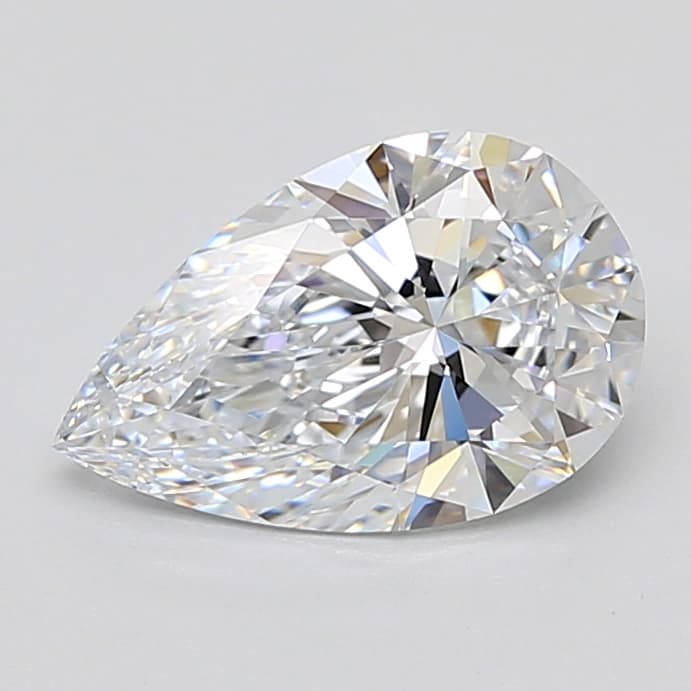
The suggestions below show live lab-grown stones just under 2 and 3 carats, so you can compare them with 2 carat and 3 carat stones directly. If you would like a side-by-side shortlist, a diamond specialist can put one together for you.
Frequently asked questions
Does a 1.9 carat diamond look smaller than a 2 carat?
Only slightly. A well-cut 1.90 ct round is about 7.97 mm across against about 8.11 mm for a 2.00 ct, a difference of roughly 0.14 mm that is very hard to see once the stone is set. Differences in cut can be larger than that, so compare the measurements on the reports.
Why do diamond prices step up at round carat weights?
Diamonds are commonly priced in weight brackets that begin at round numbers such as 1.00, 1.50 and 2.00 carats. A stone that crosses into the next bracket can be priced noticeably higher, even though the extra weight is very small. The size of the step varies, so compare live listings.
Is a 1.9 carat diamond a good choice?
It can be. A just-under stone looks almost the same as the round-number weight, and choosing one can leave room for a better cut, color or clarity. If the round number matters to you, though, that is a good reason to choose it.
What is a magic size in diamonds?
Magic sizes are the round weights, such as 0.50, 1.00, 1.50 and 2.00 carats, at which diamond prices tend to step up. Stones just below them are sometimes called sweet spots, because they look almost as large.
Glossary terms in this article
More on Color & Carat in the journal.